
Blog Detail
-
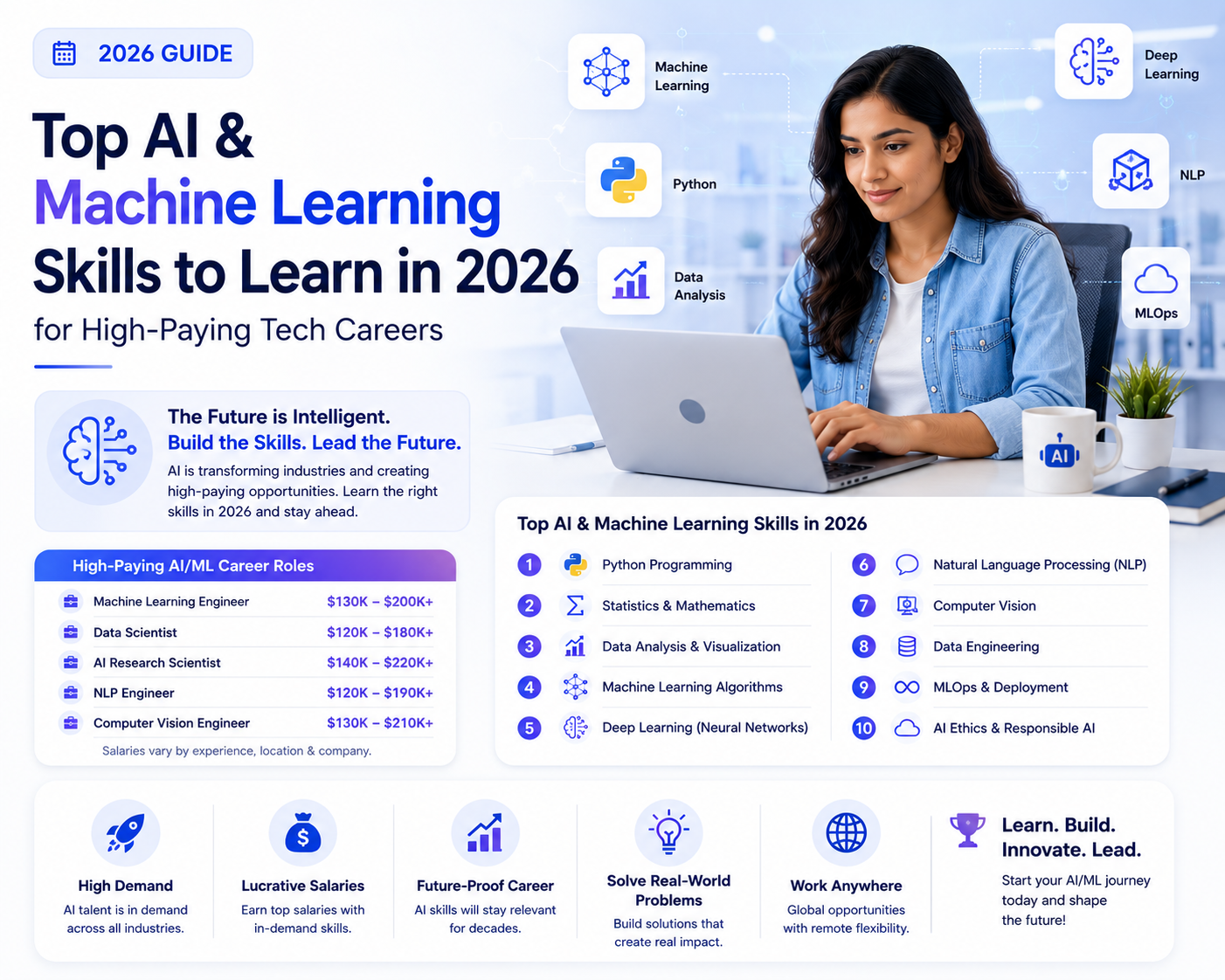
Top AI & Machine Learning Skills to Learn in 2026 for High-Paying Tech Careers
Artificial Intelligence (AI) and Machine Learning (ML) are transforming industries faster than ever. From healthcare and finance to e-commerce and automation, companies are increasingly investing in AI-powered solutions to improve efficiency, decision-making, and customer experience.
As a result, demand for AI and ML professionals is growing rapidly in 2026. Whether you are a fresher entering the tech industry or an experienced developer planning to upskill, learning AI and machine learning can unlock exciting career opportunities and higher salaries.
Why AI & ML Skills Matter in 2026
Businesses today rely heavily on data-driven decisions and automation. AI enables systems to analyze massive datasets, predict outcomes, and automate complex tasks.
Companies are hiring AI professionals for:
-
Intelligent automation
-
Predictive analytics
-
Chatbots and virtual assistants
-
Recommendation systems
-
Fraud detection
-
Generative AI products
This growing adoption makes AI one of the most valuable skill sets in the job market.
1. Python Programming
Python remains the most important programming language for AI and machine learning.
Why Python?
-
Easy to learn
-
Large developer community
-
Powerful AI libraries
-
Fast prototyping
Popular Python libraries include:
-
NumPy
-
Pandas
-
Scikit-learn
-
TensorFlow
-
PyTorch
A strong Python foundation is essential for AI careers.
2. Mathematics and Statistics
AI models depend heavily on mathematics.
Important concepts include:
-
Linear Algebra
-
Probability
-
Statistics
-
Calculus
These concepts help you understand how machine learning models work internally.
While you don’t need advanced research-level mathematics for every AI role, strong basics are extremely useful.
3. Data Analysis and Data Visualization
Data is the fuel of AI systems.
Before training models, data must be cleaned and analyzed.
Important skills:
-
Data cleaning
-
Feature selection
-
Data transformation
-
Pattern analysis
-
Visualization
Tools commonly used:
-
Excel
-
SQL
-
Pandas
-
Power BI
-
Tableau
Good data analysis improves model performance significantly.
4. Machine Learning Algorithms
Understanding machine learning algorithms is a core requirement.
Common algorithms include:
-
Linear Regression
-
Logistic Regression
-
Decision Trees
-
Random Forest
-
K-Means Clustering
-
Support Vector Machines
Learning when to use each algorithm is more important than memorizing formulas.
5. Deep Learning
Deep learning is a subset of machine learning that uses neural networks.
It powers advanced AI systems such as:
-
Voice assistants
-
Image recognition
-
Self-driving systems
-
Natural language processing
Deep learning frameworks:
-
TensorFlow
-
Keras
-
PyTorch
This skill is highly valuable for advanced AI roles.
6. Generative AI & Large Language Models
Generative AI has become one of the hottest fields in technology.
Popular AI systems include:
-
Chatbots
-
AI assistants
-
Content generators
-
Code assistants
Understanding Large Language Models (LLMs) helps developers build modern AI applications.
Important concepts:
-
Transformers
-
Embeddings
-
Fine-tuning
-
Retrieval-Augmented Generation (RAG)
This area offers massive career growth in 2026.
7. Prompt Engineering
Prompt engineering has emerged as a new skill due to generative AI.
It involves writing effective prompts to get accurate results from AI models.
Good prompt engineering improves:
-
AI responses
-
Workflow automation
-
Productivity
-
AI application quality
Many companies now value prompt engineering expertise.
8. Cloud Platforms for AI
Modern AI systems often run on cloud infrastructure.
Popular cloud platforms:
-
Amazon Web Services
-
Google Cloud
-
Microsoft Azure
Cloud knowledge helps with:
-
Model deployment
-
AI APIs
-
Scalable inference
-
Distributed training
Cloud AI skills increase job opportunities significantly.
9. Model Deployment and MLOps
Building a model is only part of the job.
Companies also need engineers who can deploy and maintain AI systems in production.
Important areas:
-
API integration
-
Docker
-
CI/CD pipelines
-
Monitoring
-
Model retraining
MLOps bridges machine learning and DevOps.
10. Communication and Problem Solving
Technical skills alone are not enough.
AI professionals must explain complex results to business teams and stakeholders.
Strong communication helps with:
-
Presenting insights
-
Explaining model predictions
-
Collaborating with teams
-
Solving real business problems
These soft skills can greatly accelerate career growth.
Career Opportunities in AI & ML
Learning AI and ML opens doors to many roles:
-
AI Engineer
-
Machine Learning Engineer
-
Data Scientist
-
NLP Engineer
-
Computer Vision Engineer
-
AI Product Developer
-
MLOps Engineer
Many of these roles offer some of the highest salaries in the tech industry.
Final Thoughts
AI and machine learning are no longer optional future technologies—they are shaping the present and future of software development.
In 2026, professionals who combine programming, machine learning, cloud, and problem-solving skills will have a major advantage in the job market. Start with fundamentals, build projects, and keep learning consistently to stay ahead in the AI revolution.
-